
The second round of the Indo-United States strategic dialogue, co-chaired by External Affairs Minister S M Krishna and US Secretary of State Hillary Clinton, has been postponed in view of the Assembly elections in India and ongoing developments in West Asia and North Africa.
India and the United States will hold the second round of their strategic dialogue in New Delhi on April 6 during which US Secretary of State Hillary Clinton would lead the American side, Foreign Secretary Nirupama Rao has announced in Washington.
United States Secretary of State Hillary Clinton will arrive in New Delhi on Monday to attend the second round of Indo-US strategic dialogue on Tuesday during which a host of key bilateral, regional and international issues including situation in Afghanistan and Pakistan and security cooperation in the backdrop of recent Mumbai blasts will be discussed.
The talks between S M Krishna and Hillary Clinton covered important bilateral issues like Afghanistan, nuclear waiver, defence purchases, terrorism, cyber security and US demands for market access, particularly in insurance and retail trading. Sheela Bhatt reports.
Significantly, the official spokesman of the Russian foreign ministry said in a statement posted on the ministry's website that the new guidelines adopted by the NSG to ban the sale of ENR technology to NPT non-signatories would not apply to India. This unambiguous statement was made just a few days before the Indo-US Strategic Dialogue
Doubts about the Obama administration's commitment to a strategic partnership with India were raised by the likes of Lalit Mansingh, former Indian ambassador to the US and former Indian foreign secretary, and Kanwal Sibal, former Indian foreign secretary and former deputy chief of mission in Washington, DC, in two separate panels titled 'American and Indian Strategic Interests in Asia' and 'Where is the US-India Strategic Relationship Headed in the Coming Year?'
United States Secretary of State Hillary Clinton, who will be visiting India from July 19 for second Indo-US strategic dialogue in New Delhi, will also be travelling to Chennai.
Close on the heels of a highly successful Indo-US Strategic Dialogue in early June, as many as five Union ministers are scheduled to visit US next week to hold series of talks with their American counterparts.
Ahead of Indo-US Strategic Dialogue, an Obama Administration official termed India as a "great and emerging global power" and said the talks, next week, will take the relationship between the two nations to a new level.

Ahead of Indo-US Strategic Dialogue, an Obama Administration official on Thursday termed India as a "great and emerging global power" and said the talks, next week, will take the relationship between the two nations to a new level.
United States firm Westinghouse Electric and the Nuclear Power Corporation of India Ltd on Wednesday signed a preliminary pact for an Early Works Agreement for installation of the first 1,000 MW American nuclear reactor in India under the historic 2008 Indo-US civil nuclear deal.
Addressing a joint press conference in Washington along with Pakistan Foreign Minister Shah Mehmood Qureshi, US Secretary of State Hillary Clinton said that over the next few days the strategic talks will focus on Pakistan's energy and water needs.
After her meeting with External Affairs Minister S M Krishna, US Secretary of State said that Indo-US strategic partnership can be upped beyond 3.0 level that she had envisaged. Aziz Haniffa reports
United States President Barack Obama and Prime Minister Manmohan Singh have vowed to strengthen the robust Indo-US relationship and discussed a wide range of bilateral and regional issues, including Afghanistan and nuclear terrorism.
Focusing on five key areas including security cooperation and trade, United States Secretary of State Hillary Clinton on Wednesday said India and the United States are moving to forge a new and more mature phase of ties, as the 3rd Indo-US strategic dialogue kicked off in Washington, DC.
Hillary Clinton is scheduled to travel to India on Thursday -- her first visit as secretary of state -- which she has been saying would be the starting point of a new Indo-US relationship.

Prime Minister Narendra Modi and US Vice President JD Vance have expressed satisfaction with the progress made in negotiations for a bilateral trade agreement. The two leaders met in New Delhi and discussed a range of bilateral issues, including cooperation in energy, defense, strategic technologies, and other areas. They also exchanged views on regional and global issues of mutual interest.
India has asked the United States to provide statements of 13 people associated with Lashkar-e-Tayiba terrorist David Headley and his accomplice in Mumbai terror attack case Tahawwur Hussain Rana as they could be potential witnesses.

United States Vice President Joe Biden will travel to India next month, his first official visit after assuming the position in 2008.
"We are burning the midnight oil, working our fingers to the bone," he said, to ensure access to Headley for India, as it was "so important to India, the Indian people, the Indian government."

On a two-day official visit to India, she is accompanied by 25-member delegation including top security officials in the US Administration and will hold talks with her counterpart External Affairs Minister S M Krishna on a host of key bilateral, regional and international issues.
India's 8 percent-plus growth has opened up opportunities where India is, for the first time, in a position to offer unprecedented opportunities to US businessmen in the nuclear power, space and manufacturing sectors.
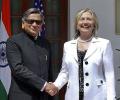
US Secretary of State Hillary Clinton after the second round of Indo-US Strategic Dialogue with her counterpart S M Krishna, made it very clear that there were "issues" which required to be resolved by the two sides in the civil nuclear field. But she did not go into the specifics.
"The N-deal is not only the highest visible symbol of cooperation between India and the United States, it represents a new turn -- it is a very special cooperation."
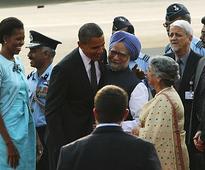
After the second US-India strategic dialogue, Aziz Haniffa finds growing concern about the civilian nuclear deal trapped in limbo.

The composition of the US delegation led by Secretary of State Hillary Clinton to next week's India-US Strategic Dialogue in New Delhi points to the wide-ranging scope of talks between the two countries.

The last meeting of the 2+2 was held in New Delhi and the next meeting is to be hosted by the US in Washington, DC.

Recognising the threat posed by outfits like the Al Qaeda, Lashkar-e-Tayiba and the Dawood Ibrahim network, India and the United States have agreed to deepen cooperation in fighting terrorism and asked Pakistan to bring to justice the 2008 Mumbai attack perpetrators.
Hillary Clinton's recent visit notwithstanding, the divergence between the US and India remains as stark as ever.
Headed for New Delhi next week, new US Ambassador to India Nancy J Powell has said realizing the true potential of economic relationship between India and the US would be her top priority.
The Obama Administration has reiterated its strong commitment to the US-India civilian nuclear deal consummated during the tenure of the previous George W Bush Administration and said it's "embedded" in a broader strategic dialogue between Washington and New Delhi, but contended it's certainly not a template for negotiations with the likes of Iran.
United States Secretary of State Hillary Clinton, in opening the first-ever US-India Higher Education Summit at Georgetown University in Washington, DC, -- which she co-chaired with Minister of Human Resource Development Kapil Sibal -- declared that while collaboration in this sphere is a driving force in the strategic dialogue between Washington and New Delhi, whether it will ultimately succeed or not depends on those outside government -- academia, researchers, and business

Secretary of State John Kerry arrived in New Delhi onto participate in the fourth round of Indo-US strategic dialogue even as US announced to invest $100 million in India's burgeoning clean energy sector.

The new framework of the ministerial dialogue was initiated in order to provide a forward-looking vision for the strategic partnership between the two countries.
US Secretary of State Michael Pompeo and Defence Secretary Mark T Esper will visit India on October 26 and 27 for the high-level dialogue aimed at further boosting defence, security and global strategic ties between the two countries.
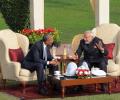
'When George Bush Senior decided in 1992 that India and the United States must start talking in this-now-changed world, who would have thought that 10, 15 years down the road, we will start looking at each other as strategic partners?'
With the Indo-US civilian nuclear deal in a limbo in the wake of the Indian Parliament's nuclear liability law, the Barack Obama administration has asserted that complete implementation of the accord is imperative for the full transformation of the relationship.
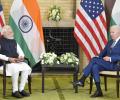
Biden praised India's Covid vaccination efforts.
Led by Ajay Shriram, chairman and senior managing director, DCM Shriram, the CEO's delegation seeks to convey to their American counterparts the sense of optimism amongst Indian industry.

John Kerry, US Secretary of State, who is here for the 2nd Indo-US Strategic and Commercial Dialogue, said his country would want its civil nuclear cooperation with India to take shape in setting up of reactors.
